Regina Bypass Awarded Corporate Innovation Award
When repairs are required on roadside equipment—such as public lighting, traffic signals, or road signs, crew vehicles must often remain on-site for extended periods.
During these operations, it’s crucial to ensure the safety of both the repair teams and road users.
This is typically achieved by keeping all the vehicle’s hazard and safety lights illuminated throughout the duration of the repair. Additionally, various power tools (such as electric drills, saws, and other hand-held equipment) are needed to complete maintenance activities efficiently.
Traditionally, the electrical power for both the vehicle’s safety lighting and these necessary tools has been provided by keeping the vehicle’s engine idling. This continuous engine operation is powered by diesel or gasoline, resulting in ongoing fuel consumption and emissions.
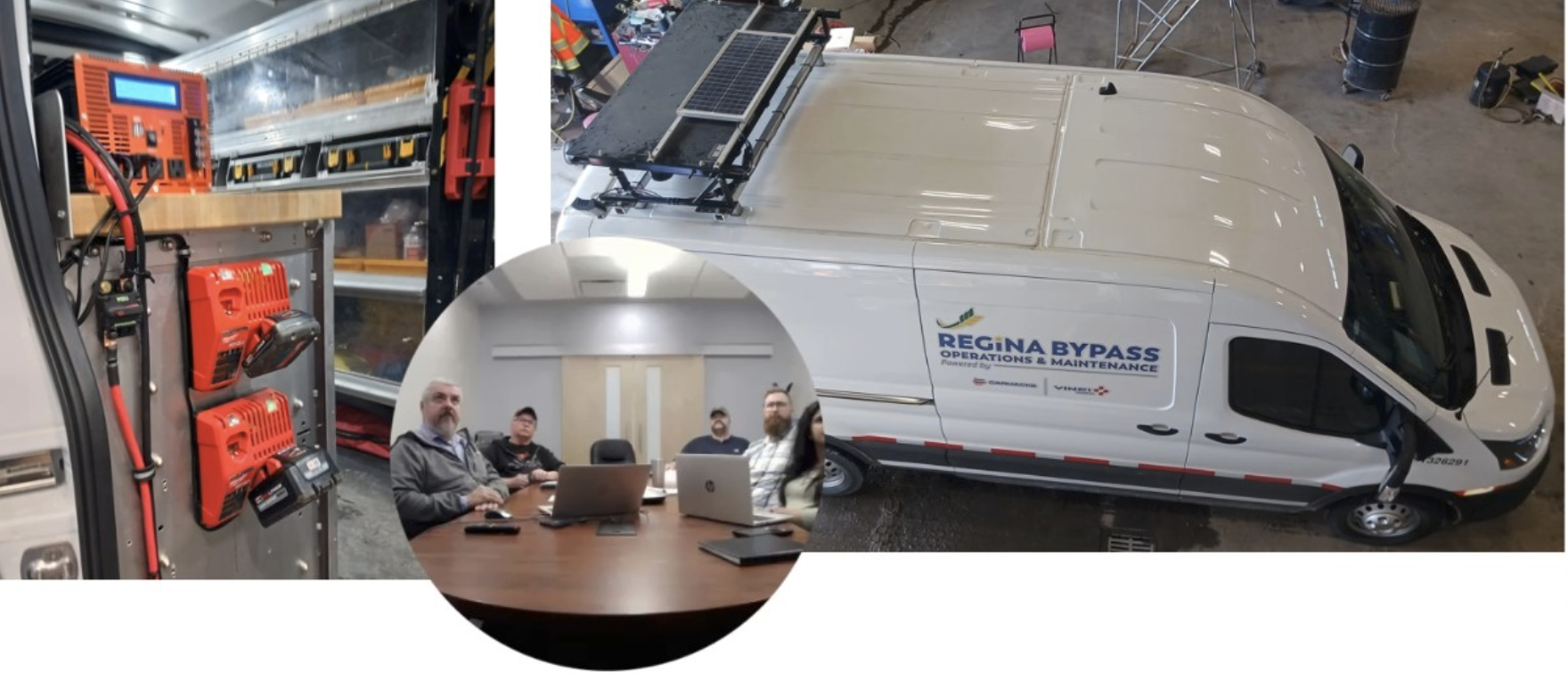
To address the environmental and operational drawbacks of engine idling, we tested an alternative mobile power solution.
Specifically, we equipped a service van with a solar panel mounted on its roof, connected to a 12V battery.
This setup stores solar energy during daylight hours, which is then converted to standard 110V or 220V AC power via an inverter, making it usable for both vehicle safety systems and a range of electric tools.
In practical on-site tests, we operated the safety lights continuously for one hour while also using standard power tools—such as drills—to repair signs.
During these trials, the power supplied by the solar panel and battery system proved sufficient to sustain all vehicle hazard and warning lights and to support most of the common electrical tools required for minor to moderate repairs on roadside infrastructure.
The setup reduces reliance on the vehicle’s engine, making the process quieter and more environmentally friendly.
Furthermore, because the power supply is available independently from the engine, there is no risk of unintended battery drain leaving the vehicle stranded.
From an environmental perspective, substituting idling engines with renewable energy has multiple benefits.
Fuel savings directly decrease the demand for oil extraction and refinement, which are major disruptors of natural ecosystems and biodiversity. More notably, cutting back on fuel consumption means lower emissions of carbon dioxide (CO₂)—a critical factor in combating climate change.
According to standard emission factors, burning one liter of petrol emits about 2.3 kilograms of CO₂. If a vehicle’s engine typically consumes between 2 to 5 liters of fuel per hour of idling during maintenance activities, avoiding this with a solar-powered system can prevent the release of approximately 5 to 11.5 kg of CO₂ per hour.
Over time, the impact becomes significant: for example, 200 hours of solar-powered operations could prevent the emission of approximately one metric ton (1,000 kg) of CO₂. Besides environmental benefits, this solution maintains all existing safety standards for both operators and the public.
The safety lights remain fully operational, ensuring high visibility of the worksite. Additionally, running quiet, emission-free equipment can improve working conditions for crew members, particularly in confined or urban spaces where noise and exhaust fumes are a concern.
In summary, replacing traditional engine idling with a solar and battery-based power system in roadside maintenance operations delivers multiple advantages.
These include a reduction in fossil fuel consumption, lower greenhouse gas emissions, decreased disturbance of wildlife and habitats, ongoing compliance with safety requirements, and potentially reduced operational costs.
This approach aligns with broader sustainability goals and demonstrates practical steps towards reducing the environmental footprint of essential public services.